The brown recluse venom is more potent than even that of a rattlesnake.
USA Spider Identification Chart
Brown Recluse Spider Bite Pictures
(Do it yourself spider traps)
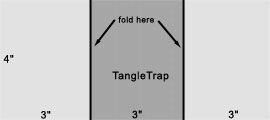
Hunting & wandering spider control Most spiders stay close to their webs lying in wait for prey. Some spiders, however, wander in search of prey, or mates at certain times of the year. Male hobo spiders (in fall) and brown recluse spiders are of this hunting/wandering type. Since wandering species move from place to place they are more likely to be found indoors. The number of spiders found indoors can be greatly reduced using simple sticky traps without the use of insecticide sprays. | | Construction layout for homemade a spider trap. Fold along lines and tape along top to make a triangular "tube". |
|
|
Sticky traps are made of cardboard with a sticky material coating on one surface. They are placed along baseboards where wandering spiders tend to move. Spiders are trapped when they walk into the trap and try to cross the sticky surface. No insecticides or attractants (pheromones) are needed.  Spider traps can be purchased online here Spider traps can be purchased online here  or homemade. The simplest homemade trap is a piece of cardboard folded into a triangular tube about four inches long and three inches high (see layout drawing above). Coat the bottom inside surface with Tangle-Trap Insect Trap Coating™. or homemade. The simplest homemade trap is a piece of cardboard folded into a triangular tube about four inches long and three inches high (see layout drawing above). Coat the bottom inside surface with Tangle-Trap Insect Trap Coating™.
Tangle-Trap Insect Coating™ is a non-toxic sticky material that is available as a thin aerosol spray, a thicker "brushable" liquid, or as a thick paste. It is widely used in forestry and greenhouse pest management to construct traps and barriers for a variety of insect pests.
Spider Glue Traps |
|
~~~~~~~~~~~~~~~~~~~~~~~~~~~~~~~~~~~~~~~~~~~~~~~~~~~~~~~~~~~~~~~~~
Boric Acid Safety (used as an effective insecticide for roaches, spiders, bedbugs, etc. in the home)
It is a toxin that must be used very carefully for severe infestations of insects.

No comments:
Post a Comment